Neon Nostalgia
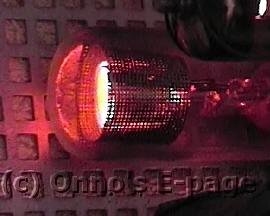
When you have glass bulb with some electrodes inside, pump it vacuum and
let just a little bit of neon gas in, you have a neon lamp.
Put a sufficiently high voltage across the electrodes, and the gas inside
will be ionized, a current starts to flow and the neon will glow in
a red-orange color.
There are several ways to build neon lamps.
Neon signs are shaped long glass tubes.
They need a high voltage to make the neon light over a large distance
between the positive and negative electrode.
In smaller neon lamps, a different type of discharge is used.
At a moderate voltage the neon gas will already light.
This type of discharge is called glow discharge.
The discharge area is a thin blanket in the area around the
cathode (the negative electrode).
The blanket will form holes if the current is lowered.
If the current is too high, some ions will leave the cathode and the
color of the light will change. Eventually this will damage the lamp.
Neon glow lamps can be used as indicator lights, displays and even
as voltage stabilisers .
This is because the working voltage is determined by the physical
properties of the glow discharge, that can be determined by the
designer of the tube.
Some very intricate applications have been developed such as
counter tubes where the ignited plasma is handed over from
electrode to electrode like the stick in an estafette race.

Nixie tubes
From 1950 to 1970 Nixie-tubes were a common technique for displaying
numerical data.
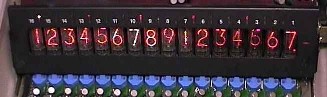
Within a nixie tube, there are a number of cathodes (usually 10),
shaped as numerals from thin metal wire.
The stack of numerals is enclosed by a fine mesh of thin wire,
which is the anode.
Only one cathode is used at a time, the glow discharge around the
cathode, will make the neon around that cathode light
in the shape of a warm, velvety, red-orange digit.
The wire-numerals are placed in front of each other.
When a nixie tube is displaying the contents of a running counter,
you can see the digits jump to and fro.
The dancing digits make the nixie tube a fascinating thing to look at.
On a separate page
How To Drive Nixies,
I'll discuss the principles for nixie driving circuits.
In December 1999, I caught the nixie fever.
I found that a local electronics surplus shop in The Hague had
some boards containing 12 nixies each, at a very nice price.
I couldn't resist and bought two of them, one with multiplexing
circuitry and the other just a bus board, handy to experiment with.
After that, I started imagining what I could do with it.
- Make a nixie clock.
Building nixie clocks has really started to be a rage in the late 1990-ies.
Here are some nice examples.
On nixieclocks.de
you'll find beautiful photographs and you can also find kits to construct
a clock yourself.
But please, don't rip apart vintage equipment,
only use new nixies from old stock!
Mike's Electric Stuff
tells you how to build a nixie clock using common CMOS ic's.
Tom Jennings of World Power Systems
builds elaborate nixie clocks and sells them at astronomical prices.
His clocks seem to be based upon microcontrollers.
Jason Rand Harper makes nixie clocks and a dekatron clock and
sells them through Ebay.
David Weiner of WestDave
builds electronic clocks that are different. Some of them use nixie
tubes. Be patient while his page loads, you'll get tons of pictures.
Finally, Cosmodog
has made a
nice clock.
Looks like he's found some quite large nixies!
- Make a digital voltmeter.
There are some references on the web from people who have made plans
to do this, but I never saw their results.
I have tried this too.
I built a breadboard prototype using an ICL7135 voltmeter chip, which
did work for DC measurements,
but I never finished it.
In the meantime here is a description of a
digital panel meter
kit that I found in RB magazine.
And in december 2001 I found a
Heathkit IM1202 digital multimeter and found
the circuit diagrams on the The Circuit Archive website, that has
unfortunately disappeared since.
A number of its pages can be found at
The Heathkit Circuit Archive
page on the
UK Vintage Radio Repairs and Restoration" site.
- Build a frequency counter.
I built a TTL counter with 4 nixies 20 years ago.
Unfortunately, it got lost in a removal.
If you want schematics,
there are a few descriptions of Heathkit frequency counter kits on
The Circuit Archive.
There is also some Heathkit stuff on
the BAMA boat anchors site.
Pandicon multi-digit nixies
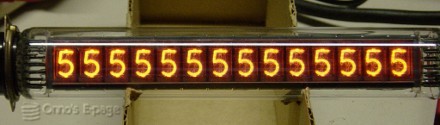
Philips and some of their sub-brands fitted 8-14 nixie displays in a single
tube.
These so-called “Pandicon” displays were intended for
multiplexed displays for calculators etc.
They have a B17A base on both ends. One has all the
anode connections, the other is connected to the cathodes.
I have two different pandicons in my collection, an 8 digit ZM1200
and a 14-digit ZM1200.
Panaplex displays
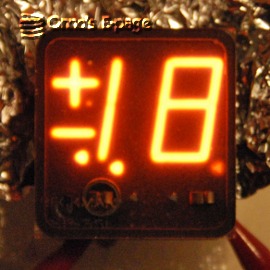
There is another way to build numeric displays using neon glow discharge.
One can arrange a number of metal strips in a 7-segment arrangement.
This flat configuration can easier be read from an angle
than Nixie tubes.
Though the digits are not as well formed as nixie digits, these flat 7-segment
displays have the same pretty orange glow as Nixies.
Sperry corporation produced multi-digit 7-segment
flat planar displays
under their “Panaplex” brand name.
I particularly remember them from some advanced pinball machines in
my youth.
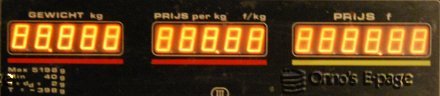
I found a Berkel scale
from a grocery shop that used these Panaplex displays.
My Nordmende DiVo 3362 Digital voltmeter
and my Feedback FM610 frequency meter
also have them.
Philips also produced flat 7-segment neon displays.
These were sold under their “Pandicon” trade mark.
I have some ZM1500 7-segment pandicons.
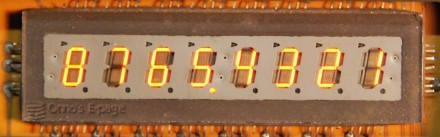
I also have a
Japanese calculator
that has a similar 8-digit 7-segment flat neon display.
Neon stabiliser tubes
The fact that the voltage across a neon glow lamp is rather stable, can
be used to produce a reference voltage. There are neon stabiliser
tubes for voltages from 70-150 V (the 150 V types would contain other
gases than just neon, as can been seen by the different, purple color
that for example a 150B2 emits).
My old high-voltage regulated power supply uses a very old Japanese
neon stabiliser as a voltage reference.
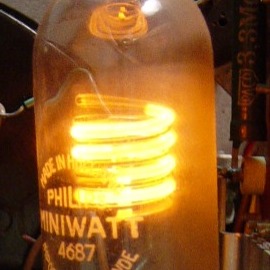
The GM7635 valve voltmeter has a 4687 neon stabiliser to stabilise its
power supply and minimise drift.
The 4687 is particularly charming because of its spiral electrodes.
Vintage equipment
I have a few pieces of electronic equipment that use nixie tubes or
other types of neon displays, such as calculators and weighing
equipment:
measuring instruments:
Nixie panel meters
Besides complete multimeters, I also have some of
panel meters, actually half-products to be built into
a switch panel or larger instrument.
My nixie clocks
I also have some nixie clocks. Two I built and one I was given.
In this 21
st century, they strongly remind me of the
20
th century and specifically the 1950's and 1960's,
the “space age” with its optimistic expectations of
the way high technology would shape the future of mankind.