Philips 470U (1938)
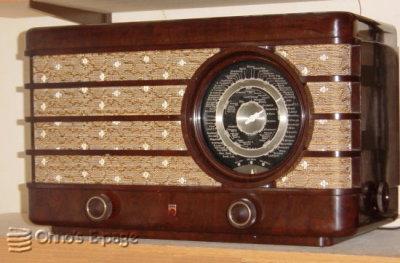
The Philips 470U and 470A models are nicknamed Zonnetje
(little sun).
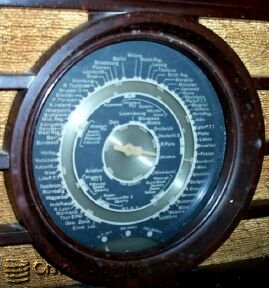
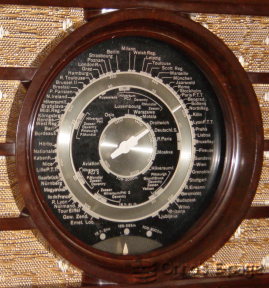
This nickname refers to the round tuning dial with the shining metal
disk behind it, usually looking like gold.
This 470U has probably been built in Belgium and has a silver disk.
The "U" in the 470U stands for "universal" radio,
i.e. suited for AC and DC mains.
The 470A is suitable for AC mains, it has
has a power transformer and uses a different set of valves.
The 470U is a standard uncomplicated superheterodyne receiver with a
single IF amplifier and no AF pre-amplifier.
Its sensitivity is good enough, though.
All the valves are types with a 200 mA heater.
The heater voltages add up to 77V.
The excess voltage in the heater chain is dropped over a ballast lamp.
One has to replace the ballast lamp to change the mains voltage,
there is no mains voltage switch.
The valve line-up of the 470U is:
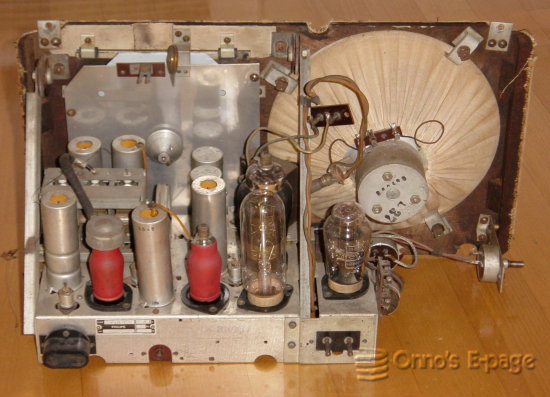
- EK2 frequency changer
- EF9 IF amplifier
- CBL1 as output amplifier and detector
- CY1 rectifier
- Type C8 ballast lamp (for 220V operation).
I had fallen in love with this model and bought this one a bit impulsively.
As it turned out, this particular specimen had some good and some bad sides.
On the bad side is its silver disk.
(why did I buy I one with a silver disk when I wanted a golden one?).
This probably means it has been produced in Belgium.
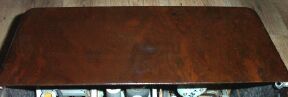
On the good side was the very good shape the Philite (bakelite) case was in,
it just needed a lot of polishing.
Well, one of the bars in front of the speaker was chipped in one place.
I was happy with that, because on many of these older bakelite
AC/DC radios the top of the
cabinet is warped and cracked by the heat of the ballast lamp.
Though Philips has fitted a sort of heat shield on the upper inside of the
cabinet, on the long term this will not be enough to prevent damage.
The ballast lamp dissipates 30 W, this is a lot of heat to slowly
degradate the material. So I was lucky to have one with a smooth top.
The radio was quite dirty when I bought it.
The previous owner had told me it had been stored on an attick, and that
his grandfather had bought if from a farmer in Belgium.
That must have been a damp attick.
There were even spots of fungus growing on the Philite case,
which I find extraordinary on a chemical substance like Bakelite.
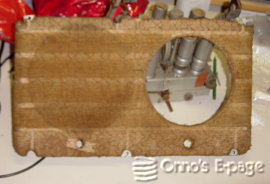
The speaker cloth had become dark brown.
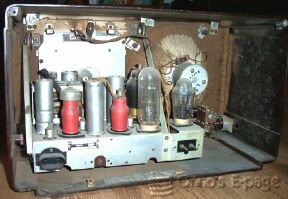
When I opened the radio to clean it out, there was a layer of 3 mm
of dark brown dust laying on the bottom of the case.
This dust felt quite dense, it turned black when cleaned with a wet rag,
so I assume it was some kind of clay dirt.
The same type of dirt was on some of the components under the chassis.
Some parts were rusty, but overall the chassis looked reasonable.
The components turned out to be in good shape.
I reformed the electrolytics (these are wet electrolytics, containing
a liquid boracic acid solution) and they still showed a low leakage current.
All the paper capacitors were also in good condition,
so the only one I replaced as a cautionary measure was the mains RF bypass
capacitor.
This one can run hot, cause a short circuit or set the radio on fire.
The other capacitor you always want to replace in an old radio is the
coupling capacitor between the AF pre-amplifier and AF output stage.
But in the 470U, there is no such capacitor,
as there is no AF pre-amplifier.
The output valve is driven directly from the detector.
When I tried the radio, it came to life after some turning of the band
switch.
Incredible!
The voltages and currents were well within specifications, so the valves
still had ample emission.
It got a hint as to why the valves were like new
when I fiddled with the volume control.
The volume pot cracked and caused the radio to become silent exactly in
the range where you should get a decent living room volume.
I took a look at the potmeter and saw there was some brown goo that had
either leaked out of the pot or into it.
It looked like soldering resin and was easy to remove using acetone.
It seemed to come from one of the soldering lugs.
I decided to take the pot apart and try to clean it.
It turned out that an amount of resin had spread across the carbon strip
inside the pot, causing an interruption.
I cleaned the inside with acetone, too, and put the pot together again.
Now the radio played like a sunshine!
I think this defect explains the good condition of the case and valves.
The pot must have had a drop of excess soldering resin on one of the
soldering lugs when the radio left the factory.
This must have melted and flowed into the potmeter, causing an annoying
crack only shortly after the radio had been purchased.
The first owner must have put the radio aside very early on in its
lifetime.
It may not have been used for 60 years or more, before I fixed it.
In order to polish the case and clean the speaker cloth,
I took the radio apart.
Unfortunately, I damaged the speaker cloth when trying to clean it.
The fabric was consumed by moist and very weak.
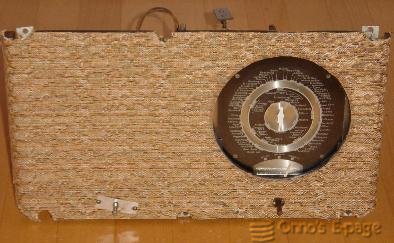
I was able to get a custom woven replacement,
which looks very good by the way.
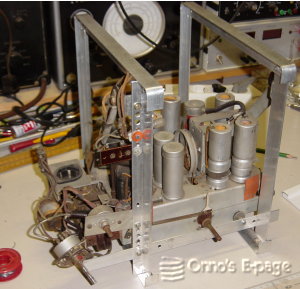
The frame is not built to stand on a workbench, so I mounted
it in a pair of brackets to handle it.
After I received the replacement cloth, I glued it to the baffle.
Then I mounted the chassis to the baffle.
The chassis is fixed to the baffle with two bolts and two
diagonal brackets.
Finally, I put the baffle back in place, fastened it with its 6 screws
to the case and mounted the knobs.
After this, the radio did not only play well,
but it looked beautiful, too.