Philips GM2882 signal generator (1945?)
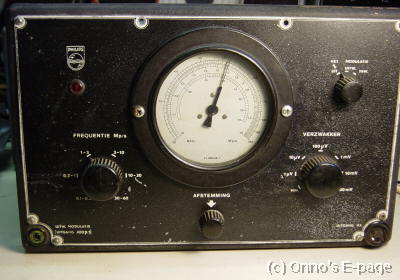
The Philips GM2882 is an RF signal generator from just after WW2.
It is a useful instrument to align radios.
This specimen isn't in terribly good shape, but I think I can fix it.
The GM2882 is an RF generator covering frequencies from 100 kHz to 60 Mhz. This is an interesting instrument. It must date from just after WW2. It comes in a steel case with rounded corners, coated with black wrinkle finish. This style of case has been used by Philips for their measuring instruments from around 1937 up until the late 1940's. The documentation I found dates from 1946. It refers to serial numbers prior to 2401 as “previous versions”. My specimen has a low serial number so it must be older than the 1946 documentation.
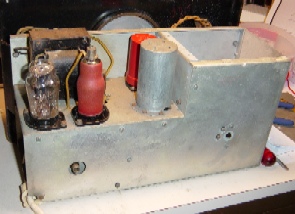
Chassis seen from behind.
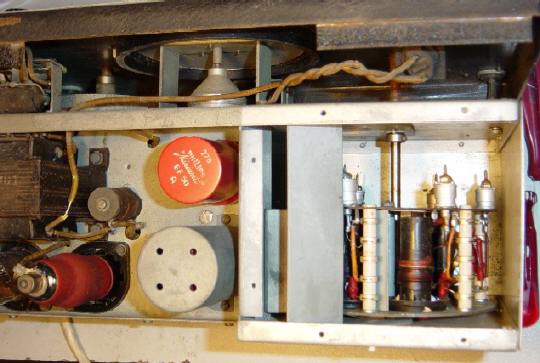
Overview from above, top of the bandswitch compartment removed to allow a peek inside.
This generator is neatly built. The range switch is a carrousel that plugs the right set of inductors for the selected range into the oscillator circuit. This reduces stray self-inductances and capacities compared to a rotary switch with its wiring and results in a stable oscillator. The tuning capacitor is driven by a tuning cord. The carrousel and tuning capacitor are placed in shielded compartments.
This generator does not have a regulated power supply. Nevertheless, Philips claims it should have a stability of better than 0,1 % after warming up.
I bought this signal generator through Internet from a trader, who sold it as a wreck. It didn't look too pretty, actually. The coaxial output cable had been cut off and the mains cord had been cut in two. The case showed considerable rust and the aluminium face plate was weathered. On the inside, though, it was in reasonable condition. The metal of the chassis is slightly corroded (white and pale green oxide) but nothing is severely rusted. The valves look excellent, as far as one can judge from the outside. The EZ2 does not show any traces of wear. The glass bulb wasn't cemented to its base any more. The EF6 is still standing firmly on its base, though. There were no traces of leakage on the power supply electrolytics, which is extraordinary. These are small (8 µF) wet electrolytics.
I will fix this generator and mount a connector on the output. I won't replace the output cable, as I find cables fixed to instruments impractical. By the way, the coaxial cable originally used on this specimen had a linen mantle and rubber insulation between the inner and outer conductor. Also, rubber insulated wire is used. In a slightly newer GM2882 I bought before this one, a coax cable with a PVC mantle was used and the wiring had PVC isolation.

Copyright © 2006 - 2012 by Onno's E-page published 2006-04-02, last updated 2012-09-23