Moving MultiMeters
When I bought an AVO model 8 multimeter in 2008,
I realised I had already gathered a small collection of multimeters
over the years.
I'd like to present them in this page.

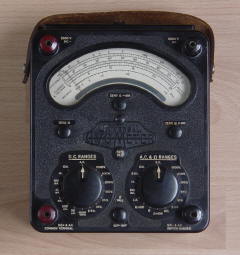
AVO model 8
AVO used to be a respected British manufacturer of electronic instruments.
They are now part of the Megger-AVO company.
Their range of multimeters was known for their robustness, precision and reliability.
The AVO model 8 is a very good instrument.
In the time it was introduced, its 37.5 μA meter movement made it
an exceptionally sensitive instrument.
In march 2007 I bought this AVO model 8 that looked very well.
The price was low because the meter movement was defective.
When I collected the meter, I had a very pleasant conversation
with the seller who had worked with different types of AVO meters a lot,
and who was pruning his collection of instruments.
When I inspected the meter for the cause of the defect,
I saw that the counterweights that balance the meter movement, had disappeared.
After some fiddling, I was able to make some replacement weights and rebalance the meter.
It is now working again. Although I should recallibrate it,
it is already a nice instrument to have and use.
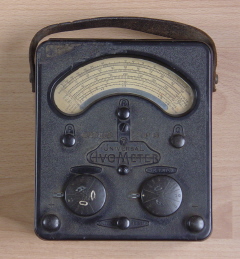
AVO model 7
The AVO 7 was a robust instrument, manufactured in the 1950-ies by the British AVO company.
Somewhere around 1982 I found this specimen on a flea market.
I remember there was a label on it from the local electricity company.
It was clear that the meter had been used heavily,
because the lettering "DC switch" and "AC switch",
engraved in the Bakelite case, had almost worn out.
I hoped that this was my chance to own and use one of those a legendary AVO meters
and decided to accept its condition.
Alas, when I inspected the instrument at home, I found it did not work.
There were signs of numerous previous repairs and some of the resistors looked scorched.
So this is a nice old instrument to look at, but nothing more.
Anyway, the AVO model 7 uses a 1 mA meter movement,
so for electronic measurements it generally loads the circuits too much.
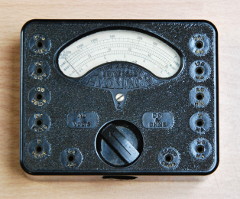
Universal AVO Minor
The AVO Minor was a smaller and cheaper model than the large
AVO 7, 8 and successors.
It is a bit rarer, though.
The switch on the front is only to select between AC and DC volts while the
actual range is set by plugging the test wire in the corresponding receptacle.
It seems AVO also had an even more “minor” model without the
AC/DC switch.
The meter movement needs 2.5 mA, which is quite insensitive.
I bought this meter through the
the Dutch Forum on Old Radios from a fellow collector in december 2012.
I'm not sure about its age.
The person selling it, said it was from 1935.
Although simple, it seems a bit too sophisticated for 1935.
A more recent specimen of the Universal AVO Minor discussed on the
UK Vintage Radio Forum
has the same type of case but a 1 mA movement. So maybe...
Anyway, the instructions on the aluminium back plate are in a type that
could
be 1930-ish. And the handwritten serial number looks ancient, too.
I asked for a serial number key on same forum, and promptly received the
answer that, by the serial number, my meter dates from 1946.
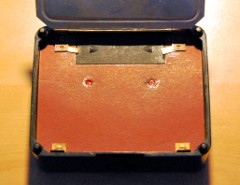
I opened the aluminium back panel to look inside.
This revealed a shallow compartment, apparently intended to tuck
away the test leads.
The bottom of the compartment consisted of a piece of red
impregnated fiberboard or cardboard, less than 0.5 mm thick.
Took the lid off the battery cover.
Found one leaky AA cell and a spring to make it fit
(originally, a slightly larger and now unobtainable type of cell was used).
I gladly removed that source of corrosion.
I removed the screws that held the cardboard bottom but wasn't able
to remove it.
It seems to be sealed in place on two places where
some kind of sealing wax can be seen in a hole with a screw
underneath.
I don't want to break these seals, so I'll leave them for now.
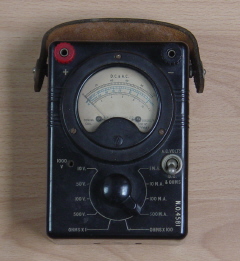
Unknown British meter
This is a British made meter I bought on a flea market somewhere around 1980.
It does not carry a recognisable brand.
Judging by its construction (it has an off-the-shelf 1 mA meter movement
and standard stock switches in a generic Bakelite box - no fancy custom case and meter)
this must be one of a small series from a small workshop.
There is a number 4581 engraved in the front.
Unclear whether this is a serial numer or an inventory number
of any workshop or company.
The meter is still working but the readings are 25 % low on all ranges.
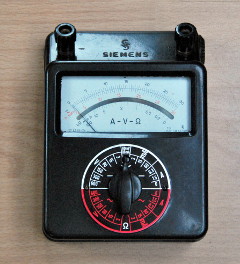
Siemens Multizet multimeter
This meter looks professional and comes in a sturdy bakelite case.
It has AC and DC voltage and current ranges.
Red colors on the range selector indicate the AC ranges.
The movement has a 1 mA sensitivity.
I saw it on the quarterly NVHR radio swapmeet in 2013
and bought it right away.
On the
Radiomuseum.org site I found a reference dating this meter around 1947.
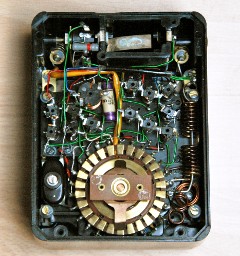
I opened the battery case and discovered it needs a non-standard size of cell.
When I removed the back panel, a pleasant bakelite and paraffine odour
emerged.
A sturdy range switch was revealed.
There were some QC stamps on the range switch and the inside of the case,
but nothing that could be interpreted as a production date.
There is a 0.02 μF capacitor that might carry a production date,
but if it does, it is just out of sight.
Besides custom-wound precision series and shunt resistors, I see one
film resistor near the ohms callibration pot that looks like the
early fifties.
The brass screws that hold the bakelite chassis carrying the
range switch and the series and shunt resistors, have a damaged slits
and the grey paint sealing them has been broken.
So is the paint on the head of the grub screw in the knob of
the range switch.
Once upon a time, somebody has repaired this meter.
To be continued.
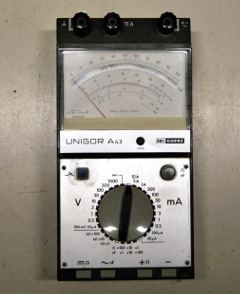
Unigor type A43
Unigor by Goertz was a brand of robust meters from Austria.
The Unigor A43 is the type of multimeter they used to have at the electronics lab.
It has a lot of ranges, it can be switched from AC to DC current
and voltage.
It has a mirror scale to enable accurate reading.
A very good and professional meter.
I bought this meter in 2014 on the NVHR swapmeet.
It does not work very well, though.
DC ranges are out of callibration and on AC I don get a reading at all.
This one needs a bit of work.
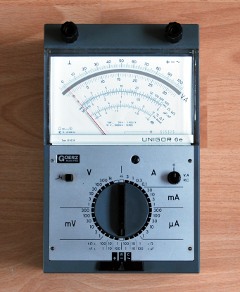
Unigor type 6E
Unigor by Goertz was a brand of robust meters from Austria.
The Unigor 6E is an electronic multimeter, meaning it has a built-in
battery-operated transistor amplifier.
This results in a sensitivity of 1 MΩ/V and a lowest DC current range
of 1 µA.
It has 54 AC and DC ranges, 13 dB ranges, 12 resistance and capacitance
ranges and 2 temperature ranges (if one has the matching temperature probe).
Goertz claims an accuracy of 1% for this meter.
It has a mirror scale to enable accurate reading.
A very good and professional meter.
I bought this meter in 2009.
It looks like it is in very good shape,
althought the test prods that came with it are
not original and the battery compartment is corroded.
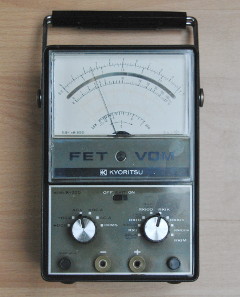
Kyoritsu K-200 FET VOM
Kyoritsu is a brand of professional measuring equipment from Japan.
This 1970-ies model is quite nice.
This voltmeter has a FET differential amplifier to enhance the sensitivity of the
instrument, making it suitable for high-impedance circuits, just like
the good old valve voltmeter (VTVM).
Interestingly, the design looks like inspired by compact VTVM's like
Heathkit IM-11D,
Heathkit V-7A
and the likes.
I bought this meter through the
the Dutch Forum on Old Radios in 2013.
A copy of a manual came with it.
It is a pity that the nickle plating on the handle has some rust speckles.
When I got it, the meter was working well but in some positions
the pointer had a tendency to stick.
I took a look at the front cover of the meter.
It had been broken once and repaired.
So maybe some dust had entered.
I removed the cover and the dial and inspected the meter movement.
Indeed there were some tiny specks of dust.
I cleaned it out with a small paintbrush and made the pointer move.
It seemed to be free now. Reassembled the meter and indeed, it is working fine.
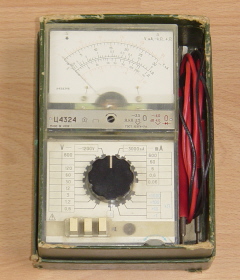
M-4324
This is a Russian multimeter that was sold in large quantities in the late 1970-ies
as a robust and precise yet affordable instrument for hobbyists.
It seems to have been inspired by the Unigor, although it is far less robust.
I bought it in 1977 for 69,- Guilders.
It has a 40 μA meter movement with a large number of scales.
The meter movement uses a taut band suspension instead of a jewel-and-spring.
It has separate AC scales to correct for the small errors introduced
by the meter rectifier.
An interesting feature of this meter is the fact that it uses 3 NiCd cells as a
battery for the resistance ranges.
This turned out to be a disadvantage rather than an advantage, as there was
no battery charger included and the NiCd cells eventually were worn by too
frequently charging them.
I replaced the button cells by size AA NiCd cells, but these gave up too.
I have used this meter for my day-to-day hobby use for a number of years
until I bought a digital multimeter in 1986.
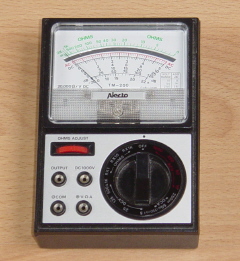
Alecto TM-200
This is a small but useful Japanese multimeter
from the late 1970-ies for the beginning electronics hobbyist.
It has a 50 µA meter movement and if offers all the ranges that a hobbyist
normally needs.
This meter was bought and owned by a good friend of mine, who gave it to me when
he decided to end his electronics hobby.
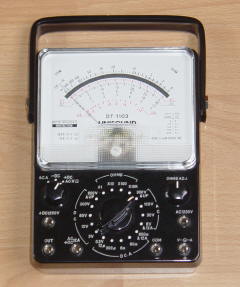
Unisound DT-1103
This is quite a remarkable multimeter because of the
10 μA meter movement.
Its sensitivity is no less than 100 kΩ/V (10kΩ/V on AC)
so that on the 1000V DC range it has a higher input resistance
than my DVM.
Its size suggests it is a professional instrument, but on the inside
it doesn't look really robust.
The only references to the Unisound brand I can find on the web, suggest
this meter was sold
by Radio Shack, which more or less confirms it's aimed at the hobbyist.
When I opened it, I discovered the two size B cells for the ohms ranges had been leaking.
The battery holders had rusted, but not too badly.
I took the battery holders apart, took the contact springs out and cleaned them.
After that I polished them and they ended up looking reasonable.
I bought this meter on a flea market at my children's school in 2006.
I did not really need it, but I found its large size and sensitive movement very
interesting.
Unfortunately, I forgot to take the instruction booklet home.
When I ran back, the seller had already left.
Anyway, even without the manual the meter is working excellently.
Copyright © 2008-2013 by Onno's E-page
published 2008-07-20, last updated 2016-04-27