FM stereo test signal generator
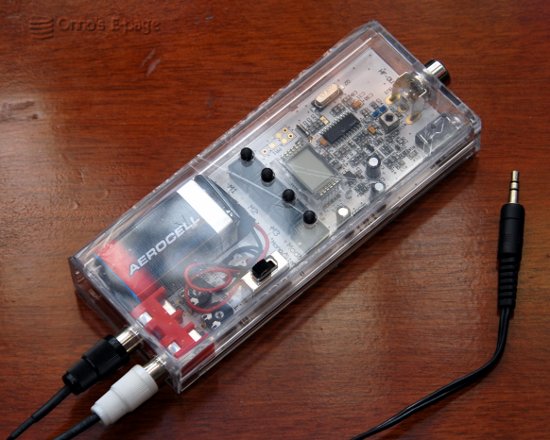
This test signal generator is a stereo-encoder and a PLL controlled
FM test transmitter.
It is based upon a single-chip FM stereo transmitter.
I built it from the SUP1 kit by
ELV
Building a complete stero transmitter would be easier than I thought. I discovered a number of IC types that contain a complete stereo encoder and even a PLL-controlled FM transmitter. These chips are used in large quantities in the tiny mini FM transmitters you can buy to play the music from your MP3-player on your car stereo.
I found out that ELV are offering an FM signal generator kit, “SUP1”, based upon the BH1415 chip from Rohm. This ic contains a stereo multiplexer with two filter pre-amps. The 19 and 38 kHz signals are derived from a 7.6 MHz crystal oscillator. The crystal oscillator is also the reference for the PLL frequency synthesizer that has a serial input to set the frequency multiplication factor. The frequency can be set anywhere from 87 to 108 MHz.
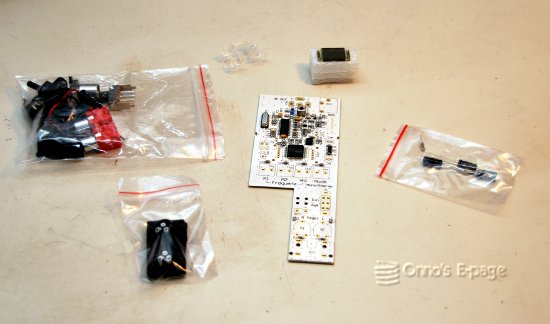
Contents of the kit, PCB almost completely assembled.
My kit arrived from Germany by mail a few days later. It was easy to assemble. ELV have already soldered all the SMD components to the PCB, leaving only the wired components and switches and connectors for me to solder.
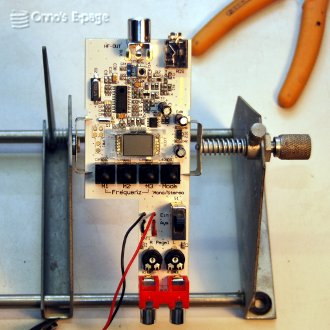
PCB is finished.
Now I wanted to hear some music. The guys from ELV are warning that it is illegal to connect the generator to an antenna. So I used a balun to connect the generator directly to the antenna input of my Philips B8X44A FM stereo receiver.
Now something odd happened. When I tuned to the generator frequency, I only heard white noise. But when I pulled the balun from the antenna input, I got strong reception of the carrier. Then I connected an MP3 player to the input and heard the music. After some experimentation, I concluded that the signal from the test generator was just too strong for the radio. The strong signal stops the local oscillator of the FM tuner, so that no frequency conversion takes place and only the noise of the IF amplifier can be heard. I tried this on another Philips receiver that had a similar FM input stage, my A5X83A AM/FM tuner and got the same result: noise if the generator is connected to the antenna input, and reception when it was disconnected. So I needed to use an attenuator between the test generator and the radio.
I tried the test generator on a few FM stereo radios to judge its performance. I found the sound level is somewhat weak. In stereo mode, distortion and hissing noises can be heard. Channel separation is not impressive. If you connect a tone to one channel and listen to the other one, you hear a weak tone with distorsion and noise.
Well, after all, this is only a simple stereo encoder. Doing some more research, I found that people who are fussy about putting a decent FM stereo signal on the air, such as the Pira.CZ pirate radio site, hate the BH1415's performance and prefere a more complex DYI stereo encoder.
So it looks like the channel separation of this test generator is too poor to be useful to align my stereo decoders. But it can be used as a simple FM test transmitter. Anyway, nice try.

Copyright © 2009 by Onno's E-page published 2009-11-28, last updated 2013-03-05