Philips PM5321 RF generator
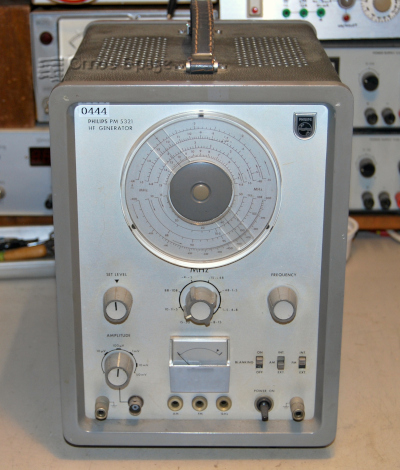
The Philips PM5321 is an RF generator suitable for a broad range of radio service activities. It is the successor of the PM5320 I also had.
This is an improved version of the PM5320. It covers the same broadcast frequency ranges and offers amplitude and frequency modulation. There is now a possibility to use an external signal for AM or FM. And it has a “blanking” switch to avoid loops in the scope image when using the FM/sweep function. Overall, it is looking a bit more modern and it is easier to use, the controls are improved. The rotary switch for frequency modulation has been replaced by a 3-position slide switch. The FM receptacle on the front can be either input or output. The AM toggle switch is also replaced by a 3-position slide.
The valve and semiconductor line-up is:
- ECC85 as RF oscillator,
- 3x AA119 diodes used as variable capacitance for FM
- E80F as RF output amplifier,
- BC107 transistor used to suppress the output valve in “single sweep” mode,
- AA119 diode as rectifier for the signal level meter,
- ECF82 as AF oscillator and driver for FM modulation,
- EZ80 as rectifier,
- PCL82 as power supply voltage regulator,
- 85A2 as voltage reference for the power supply.

I bought this RF generator in November 2024 on the quarterly NVHR swapmeet. I was surprised to find an instrument that was so similar to the PM5320 I recently had taken into use, but different. The seller was keen to offer it but I said I wasn't interested because I had a PM5320 and was happy with it. He insisted though, and at 20 Euros I couldn't say no, being curious what the differences with the PM5320 would be. I put it in a corner in my workshop for a few months before I had time to test it.
In March 2025, after finishing the KY585 radio, I set out to test the PM5321. When I took the covers from the metal case, I saw there was a little corrosion and dust on the inside, more than on the PM5320. But overall, it was looking good. The inside of the oscillator box was looking fine, too.
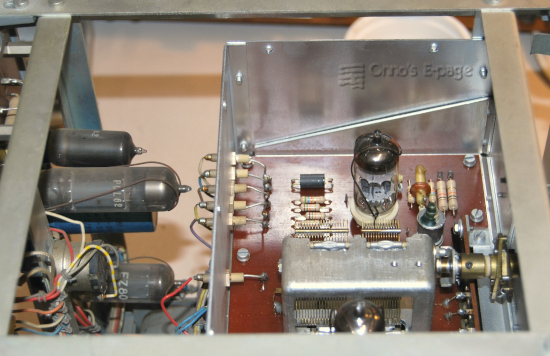
During reforming of the electrolytic capacitors in the power supply they turned out to be in excellent condition. The power supply was functioning well and I went on to test the generator. It was working fine on all ranges, although the frequencies were a bit off, like with the PM5320. You definitely need a frequency counter with these old signal generators.
After these tests, I decided to keep the PM5321, and to sell my excellently working PM5320 to a fellow hobbyist.
